Most people have never thought about where their electricity comes from beyond the wall socket. It comes from the grid — a vast, interconnected network of power plants, transmission lines, and substations that has been built up over more than a century. For most of history, that grid was the only option. You were either connected to it, or you had no power.
A microgrid changes that equation. It is a local energy system — with its own generation, storage, and control — that can operate either connected to the main grid or completely independently. It is the energy equivalent of a self-sufficient community that still has roads connecting it to the rest of the country.
Understanding what microgrids are, how they work, and who actually needs one matters increasingly as energy security, electricity costs, and grid reliability become pressing concerns for businesses, institutions, and communities across Europe and beyond.
What Is a Microgrid?
The US Department of Energy defines a microgrid as: a group of interconnected loads and distributed energy resources within clearly defined electrical boundaries that acts as a single controllable entity with respect to the grid. A microgrid can connect and disconnect from the grid to enable it to operate in both grid-connected or island mode.
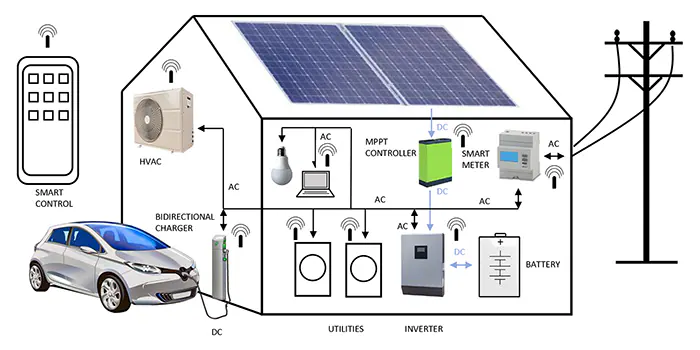
In practical terms: a microgrid is a local power system that includes one or more sources of electricity generation (solar panels, wind turbines, generators, fuel cells), energy storage (typically a battery system), loads (the buildings and equipment being powered), and a control system that manages the flow of power between all components and decides when to connect to or disconnect from the main grid.
The defining capability — the feature that distinguishes a microgrid from simply having solar panels and a battery — is islanding: the ability to disconnect from the main grid and continue operating independently during a grid outage, without interruption to the loads it serves.
⚡ Grid-connected vs island mode
In grid-connected mode, a microgrid operates in parallel with the main grid — importing power when local generation is insufficient and exporting surplus when it exceeds local demand. In island mode, the microgrid disconnects from the main grid — typically triggered automatically when a fault or outage is detected — and operates entirely from its own generation and storage. The transition between modes is managed by a controller that maintains stable voltage and frequency within the microgrid boundary. This islanding capability is what makes a microgrid genuinely resilient rather than just efficient.
How a Microgrid Works: The Core Components
A microgrid is not a single piece of equipment. It is a system of components working together under coordinated control.
Generation Sources
A microgrid can incorporate any combination of distributed energy resources:
Solar PV is the most common generation source in modern microgrids — cost-effective, scalable, and available across most geographies. Output is variable (dependent on sunlight), so solar must be paired with storage or a dispatchable backup source.
Diesel or gas generators provide dispatchable backup generation — power on demand regardless of weather or time of day. In fossil-fuel-dependent microgrids, generators are the primary source. In modern renewable microgrids, they act as the backup of last resort.
Wind turbines are included in some microgrids, particularly in coastal or highland locations with consistent wind resource. Like solar, wind is variable and requires storage or backup.
Fuel cells — particularly hydrogen fuel cells — are an emerging component of high-resilience microgrids. They provide clean, dispatchable generation with no combustion. Adoption is growing in critical infrastructure applications.
Battery Energy Storage System (BESS)
Storage is the component that makes a microgrid function effectively. Without storage, a solar-based microgrid would lose power whenever the sun is not shining. A BESS absorbs surplus generation, stores it, and releases it when demand exceeds real-time generation. In island mode, the BESS also provides the grid-forming function — maintaining stable voltage and frequency within the microgrid boundary. Modern microgrids use LFP (Lithium Iron Phosphate) battery systems for their safety, cycle life of 4,000–6,000 cycles, and suitability for both indoor and outdoor installation.
Point of Common Coupling (PCC) and Islanding Switch
The PCC is the electrical connection point between the microgrid and the main grid. An automatic islanding switch at the PCC disconnects the microgrid from the main grid when a fault is detected — within milliseconds — and reconnects it when the grid recovers. This switch is a critical component: it must operate reliably and safely to prevent the microgrid from back-feeding power into a grid that workers may be repairing.
Microgrid Controller / Energy Management System (EMS)
The brain of the system. The controller monitors real-time generation, storage state, load demand, grid status, and energy prices. It makes continuous decisions: when to charge or discharge the battery, whether to import from or export to the grid, when to start a backup generator, and when to transition to island mode. Advanced controllers use forecasting algorithms — weather data, load history, electricity price signals — to optimise across multiple objectives simultaneously: energy cost, resilience, carbon emissions, and grid service revenue.
Who Actually Needs a Microgrid?
A microgrid is not the right solution for every situation. It is a significant infrastructure investment that makes sense when the value of energy independence, resilience, and/or cost optimisation is high enough to justify the capital cost. The clearest use cases are:
Critical Infrastructure
Hospitals, emergency services, water treatment plants, military installations, and data centres cannot afford to lose power. A grid outage that lasts hours is not merely inconvenient — it is dangerous or catastrophic. A microgrid provides the islanding capability that ensures these facilities remain operational regardless of what happens on the main grid. In Europe, extreme weather events have increased grid outage frequency — making resilience investment increasingly justifiable.
Industrial and Manufacturing Sites
Large industrial facilities with continuous operations — chemical plants, food processing, automotive manufacturing — face significant costs from unplanned downtime. A microgrid can combine resilience (islanding during outages) with cost reduction (peak shaving, solar self-consumption, time-of-use optimisation) into a single infrastructure investment. Industrial microgrids are increasingly common in facilities that also have on-site renewable generation from rooftop or ground-mounted solar.
Remote and Off-Grid Locations
Remote sites — mining operations, telecommunications infrastructure, island communities, rural industrial facilities — where the cost of grid connection is prohibitive or grid supply is unreliable have historically relied entirely on diesel generators. A microgrid combining solar, batteries, and a smaller diesel backup generator can reduce fuel consumption by 60–80%, dramatically cutting operational costs and emissions. This is one of the most compelling economic cases for microgrid deployment globally.
Commercial Campuses and Business Parks
Universities, corporate campuses, logistics parks, retail centres, and hotel complexes are well suited to microgrid configurations. A campus microgrid can serve multiple buildings from shared generation and storage infrastructure — more cost-effective than individual systems for each building — while providing the entire campus with energy independence and resilience. EV charging infrastructure across the campus can also be integrated, managed to avoid demand peaks and charged preferentially from on-site solar.
Communities and Island Grids
Community microgrids serve residential neighbourhoods, villages, or islands with a shared local energy system. They are particularly relevant for island communities in the Mediterranean, Baltic, and Atlantic regions of Europe, where connection to mainland grids is expensive or technically difficult. A community microgrid with solar and storage can dramatically reduce the cost of electricity for residents compared to diesel-based isolated grids.
Microgrid vs Solar + Battery: What Is the Difference?
This is a common point of confusion. A home or commercial solar-plus-battery system is not a microgrid in the full sense, though it shares components.
The key difference is the islanding capability and control architecture. A standard solar-plus-battery system connected to the grid does not automatically disconnect and continue operating during a grid outage — standard grid-tied inverters shut down when the grid goes offline, for safety reasons. A microgrid has a dedicated islanding switch, a grid-forming inverter or controller, and an EMS specifically designed to manage autonomous operation.
A microgrid also typically serves multiple loads or buildings, whereas a residential battery system serves a single property. And a microgrid's control system is designed for active optimisation across multiple value streams — not just self-consumption.
| Feature | Solar + battery system | Microgrid |
|---|---|---|
| Automatic islanding during outage | Typically no | Yes |
| Serves multiple buildings | No | Yes |
| Grid-forming capability | No | Yes |
| Dedicated EMS/controller | Basic | Advanced |
| Scale | Single property | Site, campus, or community |
| Complexity and cost | Lower | Higher |
| Best for | Household or single commercial unit | Critical infrastructure, campuses, remote sites |
The Economics of a Microgrid
A microgrid is a capital-intensive investment. The economics depend on the specific use case, but the value drivers are consistent:
Energy cost reduction — solar generation, battery storage, peak shaving, and time-of-use optimisation reduce the cost of electricity from the grid. In high-tariff markets with strong solar resource, this alone can justify significant investment.
Resilience value — for critical facilities, the cost of downtime avoided is often the dominant factor. A hospital that avoids a single extended outage, a data centre that maintains uptime SLAs, or a manufacturer that avoids production losses may recover a significant portion of microgrid costs from avoided losses alone.
Reduced generator operating costs — replacing continuous diesel generation with solar-plus-storage reduces fuel consumption, maintenance, and emissions. In remote sites with high fuel costs, this is often the primary driver.
Grid service revenue — where regulatory frameworks permit, microgrid operators can participate in balancing markets, demand response programmes, and frequency regulation — generating additional revenue from the flexibility of their battery assets.
A full microgrid feasibility assessment requires modelling all four value streams against the capital cost and operational expenditure of the specific system configuration. Payback periods vary widely — from 5 years for a well-optimised remote site with high diesel costs, to 12–15 years for a campus resilience project in a low-tariff market.
What the Future Looks Like
The electricity grid is changing. Solar and wind now account for a growing majority of new capacity additions globally. Distributed storage is scaling rapidly. Electric vehicles are adding flexible load. And extreme weather events are testing grid resilience in ways that were not anticipated when most transmission infrastructure was built.
Microgrids are a natural response to this new reality. As the cost of solar panels, batteries, and control software continues to fall, the economics of local energy independence improve. The global microgrid market is growing rapidly — driven by data centre demand, critical infrastructure investment, remote site electrification, and the accelerating deployment of renewables.
For organisations where energy reliability is a strategic concern — not just a utility bill — a microgrid represents a shift from being a passive electricity consumer to an active energy manager with genuine independence from grid conditions.